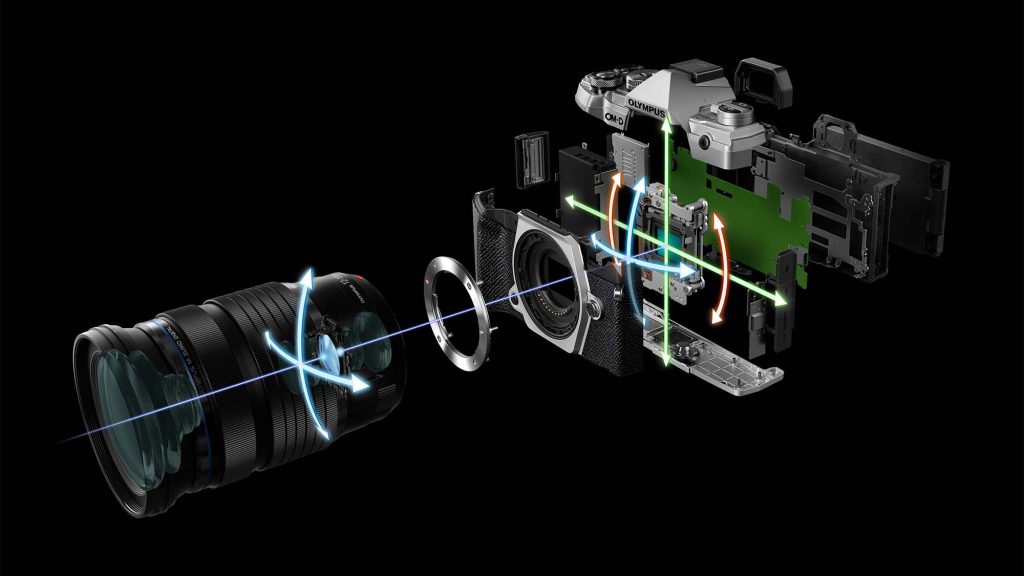
IBIS, or in-body stabilization, is considered the gold standard for image stabilisation today, and lens-based optical image stabilisers are consider old tech, or second best at least. But is that actually correct? And if OIS is so old hat, how come so many lenses still use it?
Optically stabilised lenses were common back in the DSLR days, and then mirrorless cameras arrived and, soon after that, in-body image stabilization. Many camera makers stopped making optically stabilised lenses because the cameras had stabilisation of their own.
The numbers do seem to suggest that IBIS systems offer greater shake compensation than optical stabilisers in lenses. For a start, in-body stabilizers offer compensation for five different axes of movement, whereas lens OIS typically corrects for just two, pitch and yaw. What’s more, camera makers now quote the most remarkable CIPA-tested shake compensation claims of 6 stops, 7 stops, 8 stops or more. Lens makers never made claims of that order in the past, usually limiting themselve to estimates of 3-5 stops.
It sounds like a slam dunk for IBIS, but actually all is not as it seems:
- 5 axes of stabilisation sounds inherently better than two, but that doesn’t mean you always need all five.
- Todays CIPA-rated shake compensation figures are achieved with camera and lens combinations chosen by the camera maker (see the small print alongside makers’ CIPA data). They are best-case results under specific circumstances with specific camera-lens combinations in test conditions that we should assume the makers know inside out.
- In the old days, CIPA stabilisation testing was not really a thing, so camera/lens makers generally took their best guess in the knowledge that users would soon put them right. There was no CIPA data to hide behind then.
- Lens OIS can still outperform IBIS. I can’t prove it, but I can offer my own experience. Canon’s cheap RF24-105mm f/4-7.1 kit lens has the most uncanny OIS on an unstabilised body. I know, I’ve used it with the Canon EOS R8. In my hands, this combination regularly outperforms the Canon EOS R6 II (stabilised) with the Canon RF24-105mm f/4 L IS lens combination that Canon says should give up to 8 stops of compensation. Not for me, it doesn’t. Honestly, IBIS figures are rarely indicative of real-world results.
- But perhaps the most telling thing of all is that camera makers still make lenses with OIS knowing full well that they will be used on camera bodies that themselves have IBIS. Why?
It’s because IBIS is very effective at shorter focal lengths, but less effective with telephoto lenses. Here, the ability to shift optical groups within the lens is much more effective than trying to shift the sensor to keep up with camera movement. If you are into sports and wildlife photography, lens OIS will provide a kind of stabilisation that IBIS can’t match. Conversely, if you’re shooting video at wide to medium focal lengths, lens OIS will not be able to compete with IBIS. It’s upsetting to see so many ‘vlogging’ cameras being sold without IBIS – see my IBIS hall of shame’ article.
This is why camera makers often use ‘hybrid’ IS – a combination of lens OIS and camera IBIS. It’s because it’s important. IBIS has replaced lens OIS in may people’s minds, but camera makers know it’s not that simple.
So don’t be surprised to see lenses still being sold with IOS even though many cameras now have IBIS. At longer focal lengths, IOS compensates for camera movement in a way that IBIS can’t. And don’t write off non-IBIS cameras like the Canon EOS R8 when there are lenses like the RF24-105mm f/4-7.1 that have OIS that can still put IBIS systems to shame.
Also, stabilisation claims mean nothing. Sorry, but it’s true. CIPA stabilisation figures look like a great basis for comparison, but these are best-case figures not real-world results. Annoyinglly you can never disprove a CIPA figure because you will never be shooting in the CIPA test conditions – bah!